Why BASIC is better than STAR for SWE interview use cases
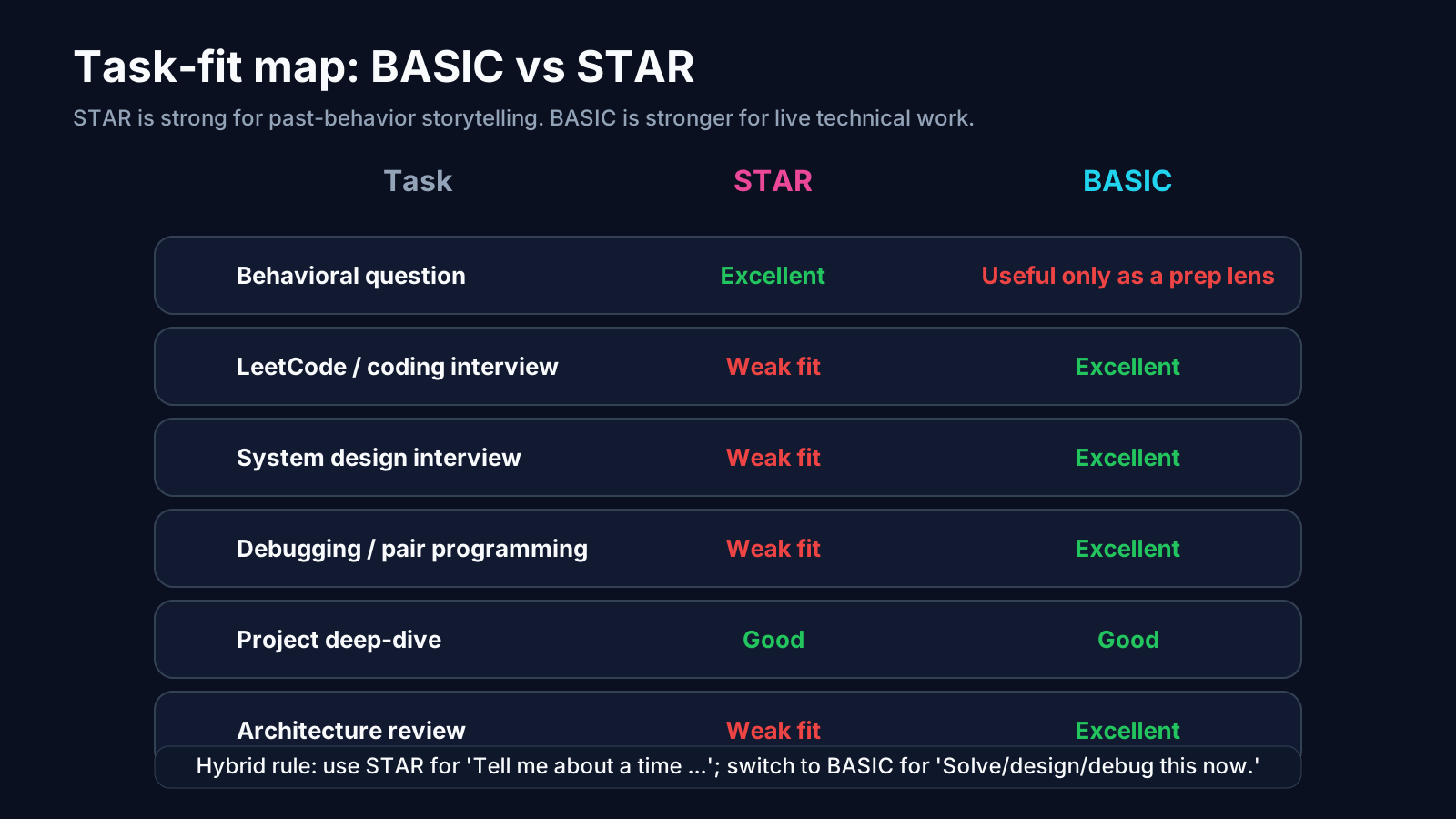
Let’s start with the honest version:
I did not find a peer-reviewed head-to-head study that randomizes software-engineering candidates into “BASIC” and “STAR” groups and proves BASIC wins. So if someone means “proven” in the narrow experimental sense, that evidence is not publicly available.
But if someone means “supported by the structure of the task, by employer guidance, and by adjacent evidence on how people solve technical problems under pressure,” then the case for BASIC is strong. That is the claim this post makes.
The short version is simple:
- STAR was designed for behavioral storytelling.
- BASIC is better suited to live technical reasoning.
Software-engineering interviews are packed with live technical reasoning.
That is why BASIC is the better default for SWE use cases like LeetCode, coding rounds, debugging sessions, architecture discussions, and system design.
The core distinction: past story vs live problem
STAR stands for Situation, Task, Action, Result. Amazon’s own materials define it as a framework for structuring answers to behavioral interview questions about past experiences. In Amazon’s guidance, behavioral-based questions and STAR are clearly separated from the rest of the interview loop. S6 S7
That matters because behavioral interviews and technical interviews ask fundamentally different things.
Behavioral interview
The interviewer wants evidence from your past:
- What happened?
- What did you do?
- Why did you do it?
- What was the result?
Technical interview
The interviewer wants evidence from your live engineering process:
- Can you decompose the problem?
- Can you compare alternatives?
- Can you build a coherent solution?
- Can you validate it?
- Can you discuss trade-offs under pressure?
STAR is excellent for the first job. BASIC is better for the second.
This is not a knock on STAR. It is a task-fit argument. Using STAR on a technical problem is like using a project-retrospective template to debug a failing deployment. It is the wrong tool, not a bad tool.
Why STAR misfires in software interviews
The easiest way to see the mismatch is to notice what STAR optimizes for.
STAR optimizes for:
- context clarity
- action ownership
- outcome framing
- story discipline
- concise evidence from prior work
All of that is useful when the question is:
“Tell me about a time you disagreed with product.”
“Tell me about a time you handled ambiguity.”
“Tell me about a time you improved reliability.”
But those are not the dominant tasks in a coding or system-design round.
Amazon’s software-development interview guidance says most technical interviews require coding and system-design whiteboarding, and that interviewers are looking for your ability to apply what you know efficiently and effectively. Their SDE II prep explicitly includes coding and system design as competencies, with system-design objectives like practicality, reliability, optimization, and scalability. S8 S9
Nothing in STAR directly tells you how to do that.
STAR has no built-in move for:
- clarifying missing constraints
- comparing brute force vs optimal approaches
- selecting data structures or invariants
- sequencing a design discussion
- dry-running code
- validating edge cases
- pressure-testing a system for failure modes
BASIC does.
BASIC matches the shape of live SWE work
BASIC is better for software engineers because it lines up with the actual workflow of technical evaluation.
Breakdown
Turns the prompt into a model: inputs, outputs, constraints, assumptions, subproblems.
Assess
Compares choices: brute force vs optimized, SQL vs NoSQL, sync vs async, tree DFS vs BFS, token bucket vs leaky bucket.
Structure
Makes the plan visible: pseudocode, invariants, request flow, data model, high-level components.
Implement
Converts the chosen model into code or deeper design detail.
Check
Verifies the answer: dry runs, edge cases, complexity, hot spots, failure modes, security, cost.
That is a much tighter match for coding and design interviews than Situation–Task–Action–Result.
The data point that makes this practical
interviewing.io analyzed a large set of technical interviews and concluded that in coding interviews it is far more beneficial to improve Code or Solve than to improve pure Communicate alone, and that in systems-design interviews extra communication points are still not worth exchanging for stronger technical and problem-solving performance. S11
This is not saying communication does not matter. It clearly does. But it does show something important:
In technical interviews, communication is valuable when it serves technical reasoning.
That is exactly where BASIC shines. BASIC is not “communication instead of engineering.” It is communication through engineering steps.
That is a major difference from misusing STAR in a technical context, where the candidate often ends up telling a shape of story instead of revealing the live mechanics of their reasoning.
Where STAR still wins
To make this fair, we should say plainly where STAR is still the right tool.
Use STAR when the interviewer asks about:
- conflict
- ownership
- leadership
- failure
- learning
- stakeholder alignment
- prioritization
- delivery under pressure
- influence without authority
If the question begins with “Tell me about a time…”, STAR is usually the safest first lens.
In fact, the strongest candidates often keep both frameworks:
- STAR for behavioral evidence
- BASIC for technical execution
That stack is stronger than trying to force one framework to do both jobs.
A direct comparison on the same SWE tasks
1) LeetCode / coding interview
Suppose the question is:
“Find the longest substring without repeating characters.”
A STAR-shaped response would immediately feel unnatural:
- Situation: there is a string
- Task: find the longest substring
- Action: I used a hashmap
- Result: returned the maximum length
That is not how interviewers want to watch the solution emerge. It collapses the live reasoning process into a retrospective summary.
A BASIC response is natural:
- Breakdown: “We need the longest contiguous substring with all unique characters.”
- Assess: “Brute force is O(n²). Because validity can be updated incrementally, a sliding window should get O(n).”
- Structure: “I’ll track counts in a hashmap, expand right, and move left when the invariant breaks.”
- Implement: write code
- Check: dry run
"abba"and"pwwkew", state O(n)
The second version reveals engineering judgment in real time. The first version does not.
2) System design
Suppose the question is:
“Design a URL shortener.”
A STAR-shaped response again feels off, because the task is not asking for a story about what you once designed. It is asking whether you can design now.
BASIC gives you a natural sequence:
- clarify requirements
- assess scale and priorities
- structure the services and data model
- implement the deep dive on IDs, redirects, and caching
- check for collisions, abuse, reliability, and cost
That is exactly the kind of stepwise system-design flow ByteByteGo recommends, and it is extremely close to Amazon’s system-design objectives. S9 S15
3) Debugging / pair programming
Debugging is often ignored in framework discussions, but it may be the clearest example of why BASIC beats STAR for SWE work.
In debugging, the winning sequence is:
- break the failure into symptoms and reproduction steps
- assess likely causes
- structure a hypothesis-driven plan
- implement the fix or instrumentation
- check whether the fix holds and what regression risks remain
That is BASIC almost verbatim.
STAR gives you a neat story after the outage. BASIC helps you survive the outage while it is happening.
Why BASIC feels better to engineers
Many software engineers dislike interview advice because it sounds like performance theater. BASIC feels different because it is close to how engineering already works.
A healthy engineering loop on the job usually looks like this:
- understand the problem
- compare approaches
- plan the design
- build something coherent
- validate and improve
That is BASIC.
This familiarity matters. When a framework matches the real work, it creates less friction and less cognitive overhead. Sweller’s cognitive-load work and later example-based learning research both support the broad principle that reducing unnecessary search and giving people structured pathways improves learning and performance on complex tasks. BASIC benefits from that same principle. S1 S16
STAR, by contrast, is not wrong. It is just optimized for a different target.
The technical-interview rubrics line up with BASIC
Karat’s candidate guide tells people to:
- understand the problem
- think through the logic and high-level structure before code
- proactively test
- simplify
- explain thought process and trade-offs
- speak up when stuck S10
That is almost a compressed BASIC checklist:
- understand → Breakdown
- logic and structure → Assess + Structure
- code → Implement
- test → Check
- explain trade-offs → Assess + Structure
- speak up when stuck → re-enter Breakdown / Assess
LeetCode’s own help center also frames its interview resources as a structural approach to interview prep. S12
So even outside academic sources, practical SWE interview ecosystems keep converging on the same insight:
Strong technical performance is easier when the candidate follows a visible sequence.
BASIC is that sequence.
Where BASIC is not enough by itself
There are two places people overclaim on this topic.
Overclaim 1: “BASIC replaces STAR completely.”
No. If the interviewer wants a past behavioral example, STAR remains excellent.
Overclaim 2: “BASIC alone guarantees offers.”
Also no. You still need:
- data structures and algorithms
- system-design vocabulary
- language fluency
- judgment built from practice
- behavioral examples
- enough reps to stay calm
The real claim is narrower and more useful:
For SWE-specific live technical tasks, BASIC is a better-fit operating model than STAR.
That claim is strong.
A practical hybrid rule
Here is the simplest way to operationalize both frameworks in one loop:
Use STAR when the interviewer asks:
- “Tell me about a time…”
- “Describe a situation…”
- “What was your biggest challenge…”
- “How did you influence…”
Use BASIC when the interviewer asks:
- “Solve this problem.”
- “Design this system.”
- “Debug this code.”
- “Walk me through how you’d build…”
- “How would you optimize…”
Use a hybrid when the interviewer asks:
- “Tell me about a system you built.”
- “Describe a project and then go deeper on the technical decisions.”
In that hybrid case, use STAR to frame the history, then switch to BASIC for the technical reasoning:
- Breakdown the goal of the project
- Assess the trade-offs you faced
- Structure the architecture
- Implement the key decisions
- Check what you learned, changed, or would improve
That hybrid is often the strongest senior-level move.
The real meaning of “better than STAR”
So what does “better” actually mean here?
Not “universally better for all interviews.”
Not “scientifically proven in a direct RCT.”
Not “more charismatic.”
It means:
- more aligned to coding tasks
- more aligned to system-design tasks
- more aligned to debugging and live collaboration
- more aligned to what SWE interviewers actually score
- more useful under technical ambiguity and time pressure
That is enough to justify making BASIC the primary framework for SWE use cases.
Bottom line
STAR is a behavioral-story framework. BASIC is a live technical-problem framework. Software engineering interviews are filled with live technical problems. Therefore BASIC is the better default for SWE use cases like coding rounds, LeetCode, debugging, and system design. The available evidence — official employer guidance, technical-interview practice guidance, large-scale interview observations, and adjacent cognitive research — all point in that direction, even if no single published paper literally randomizes candidates into BASIC vs STAR groups. S1 S6 S7 S8 S9 S10 S11 S12 S15 S16
That is the precise, defensible version of the claim.
References used in this post
S1 S6 S7 S8 S9 S10 S11 S12 S15 S16
2026 update: the AI shift makes process quality even more important
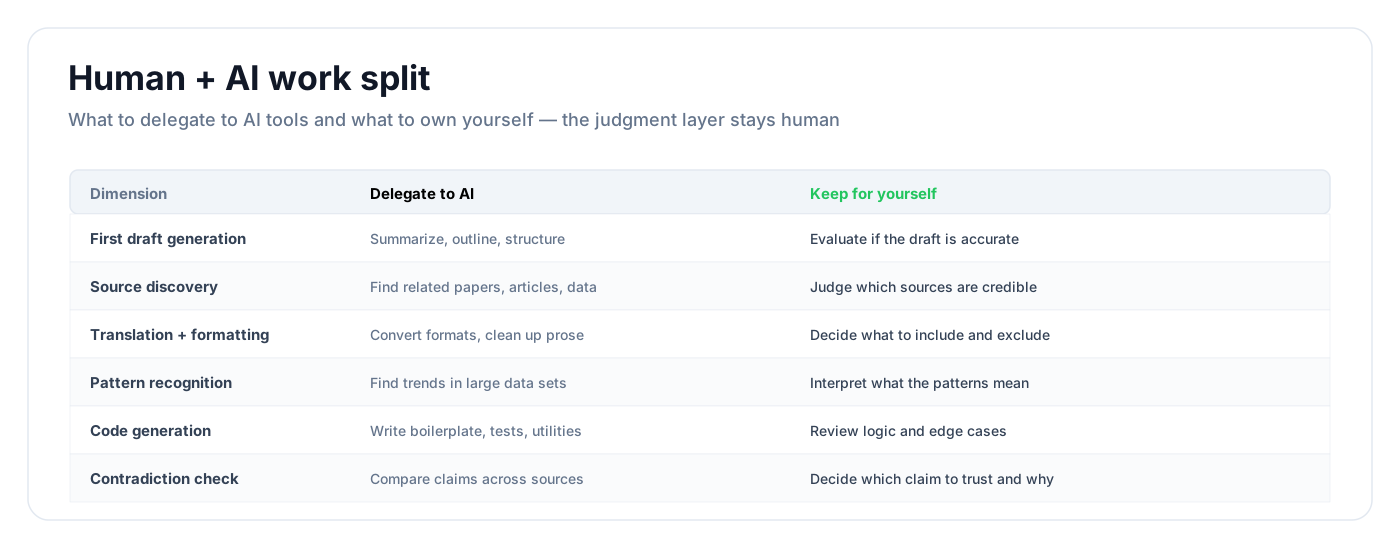
The most persuasive modern reason BASIC fits SWE work better than STAR is not only that technical interviews are live problem-solving tasks. It is that in a human + AI environment, task completion alone is weaker evidence than it used to be.
If a tool can help produce code or draft an answer quickly, the interviewer has to look harder at:
- how the problem was scoped
- how the candidate evaluated options
- whether generated ideas were tested and corrected
- whether the final answer actually fits the system constraints
BASIC is a cleaner frame for that than STAR because it already separates those phases.
STAR remains strong for a story about the past.
BASIC remains stronger for work that is happening now.
That is the decisive difference.