I stopped bombing software interviews when I learned BASIC
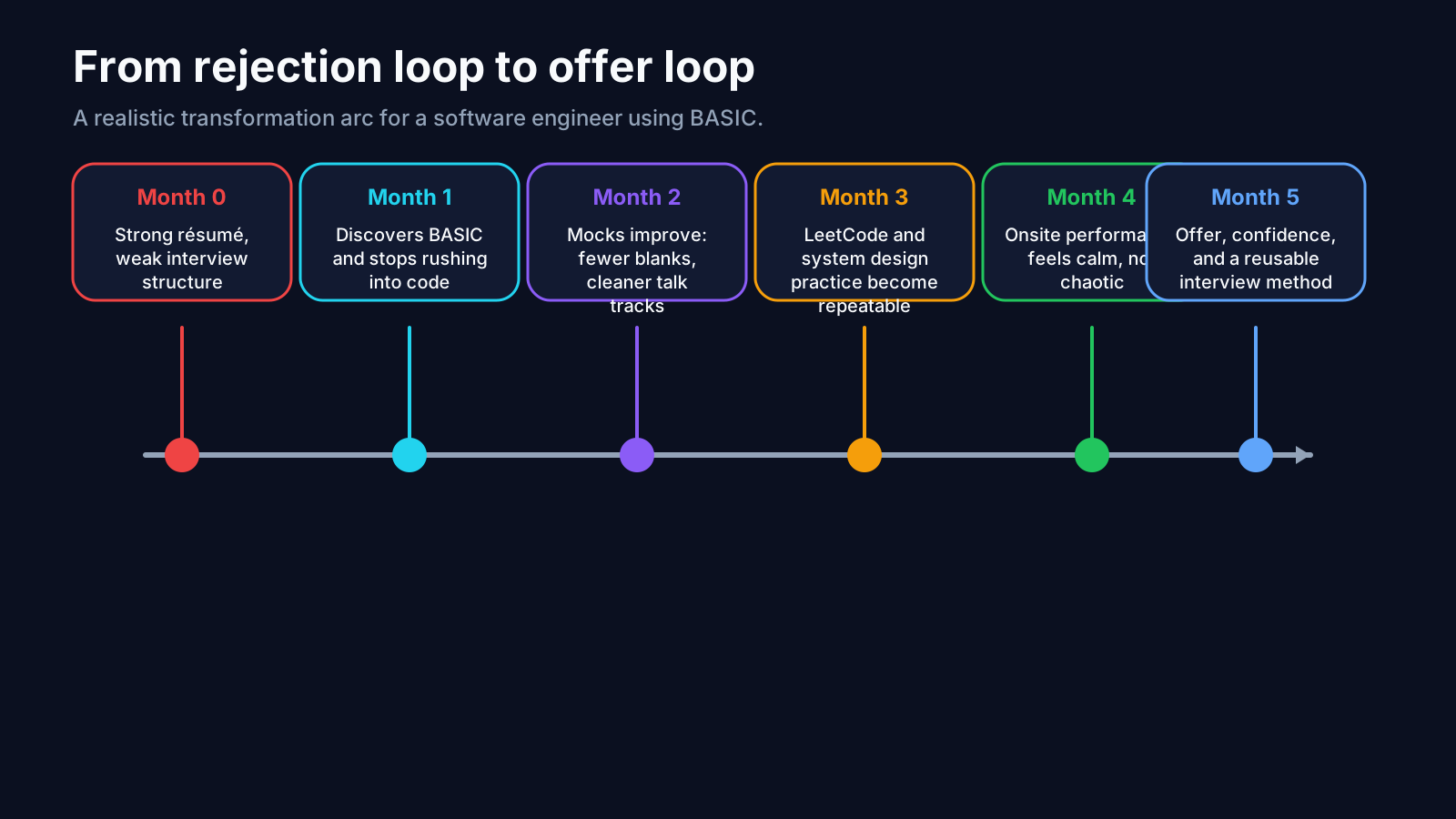
This is a realistic first-person composite story based on common software-engineering interview patterns.
I used to think my interview problem was skill.
That was the most discouraging part: I actually knew a decent amount. I had shipped backend services, cleaned up messy SQL, fixed on-call issues, and spent nights grinding LeetCode. If you looked at my résumé, you could make a reasonable case that I was ready for a mid-level software role.
But my interview results told a different story.
I would leave a coding round thinking, I almost had it.
I would leave a system-design round thinking, I said some smart things, but it got messy.
Then the rejection email would land with the same soft language:
“We were impressed with your background, but we’re moving forward with other candidates at this time.”
After the fourth rejection in three months, I stopped pretending it was random.
I wasn’t losing because I lacked intelligence.
I was losing because, under pressure, my thinking had no reliable order.
Before BASIC: what my interviews actually looked like
When I think back to how I used to interview, I can summarize it in one sentence:
I rushed to prove I was smart before I had proven I understood the problem.
A typical coding interview used to go like this.
The interviewer would ask something like:
“Given the root of a binary tree, return the level order traversal.”
I would nod too quickly. I wanted to look confident. So instead of clarifying the prompt, I would start muttering fragments:
- “Okay, tree question… probably BFS…”
- “I can use a queue…”
- “Let me code it.”
Then I would write something half-right, realize I had not thought about result grouping, backtrack, rename variables, apologize, and burn twelve minutes fighting a problem I could have solved in six if I had slowed down.
System design was worse.
“Design a URL shortener” was enough to send me into buzzword mode. I would say things like:
- “We can use Redis for caching.”
- “Maybe Kafka for analytics.”
- “Probably shard the database later.”
None of those were crazy ideas. The problem was the order. I was throwing components at the wall before we had even agreed on requirements, scale, alias rules, or the read/write path.
I sounded like someone who had watched system-design videos, not someone who could steer a system-design conversation.
What made it frustrating was that I often practiced the right content. I did LeetCode. I read system-design articles. I even reviewed common behavioral questions. But I practiced content as separate islands. I had no single operating sequence that worked across all of them.
So every interview felt like starting from zero.
The moment I realized the problem was process
The turning point was not dramatic. Nobody gave me a magical speech. I did not have a sudden genius revelation.
I failed a mock interview.
Not a real interview. A mock.
And because it was a mock, the feedback was blunt.
The interviewer said, “You’re not actually bad at this. But you keep skipping steps. You solve from the middle.”
That sentence bothered me for days.
You solve from the middle.
It was true.
I did not begin with problem definition.
I did not pause to compare alternatives.
I did not give the interviewer a structure before I coded.
And I almost never checked properly unless the interviewer asked.
I was solving from the middle.
Around that time I wrote a five-word note in my prep notebook:
Breakdown. Assess. Structure. Implement. Check.
At first it was just a memory aid. I did not think of it as a full framework. But once I started using it deliberately, it changed the feel of my prep almost immediately.
It gave me something I had never really had before:
a first step
When panic hits, the first step matters more than people admit.
Week 1: I stopped trying to “be fast”
The first thing BASIC changed was my pace.
Not my typing speed.
My decision speed.
I used to think strong candidates looked fast. After BASIC, I started to understand that strong candidates mostly look ordered.
So I made a rule for every LeetCode session:
- I could not touch code until I had done Breakdown, Assess, and Structure out loud.
- I had to say the steps even when practicing alone.
- Every problem ended with Check, whether I felt like it or not.
It felt awkward for the first two days.
I would open a problem and force myself to say:
Breakdown
- What is the exact ask?
- What are the inputs and outputs?
- What constraints matter?
- What hidden subproblems exist?
Assess
- What is the brute-force anchor?
- What pattern candidates exist?
- What trade-off am I making?
Structure
- What is my algorithm?
- What invariant or state model keeps it correct?
- What do I want the interviewer to hear before I type?
Only then did I implement.
Then I checked:
- dry run
- edge cases
- complexity
- simplification or follow-up
The strange thing was that my total solve time did not get worse. It got better.
Because I stopped wasting time on false starts.
The first LeetCode problem that felt different
The problem that made me trust BASIC was Longest Substring Without Repeating Characters.
Before BASIC, I had solved that question in the most unreliable way possible: by vaguely remembering that it was “a sliding window question.”
That is not a strategy. That is pattern cosplay.
When I revisited it with BASIC, the conversation in my head changed.
Breakdown
We need the length of the longest contiguous substring with all unique characters.
Input: string
Output: integer
Important word: contiguous
Hidden subproblem: maintain a valid window as characters repeat
Assess
Brute force: generate all substrings and test uniqueness → too slow, O(n²) or worse.
Pattern candidates:
- hashmap + scan
- sliding window with counts or last seen index
Why sliding window? Because validity changes one character at a time, so I can update state incrementally instead of recomputing from scratch.
Structure
I decided to maintain:
- left pointer
- right pointer
- hashmap of last seen positions
- best length so far
Invariant: The current window contains no duplicate characters.
Implement
Once I coded from that structure, the code felt almost boring — and that was a compliment.
Check
I dry-ran:
"abcabcbb""bbbbb""abba"
"abba" used to break my confidence. Now it became part of the routine.
That was the first moment I thought:
Oh. This is what people mean when they say a framework makes you calmer.
Not because the question got easier.
Because the order got more trustworthy.
Week 2: BASIC turned trees from panic into sequence
I had always been weirdly emotional about tree problems. The moment I saw a binary tree, I felt my brain split into ten possible directions:
- recursion
- BFS
- DFS
- base cases
- nulls
- traversal order
- stack vs queue
- parent-child confusion
BASIC cut through that noise.
Take Invert Binary Tree.
Before BASIC, I would say, “I know this one,” then rush into code and sometimes still mess up the order of operations.
After BASIC:
Breakdown
Swap left and right child at every node.
Assess
Two natural paths:
- recursive DFS
- iterative BFS with a queue
Recursion is simpler because each subtree is the same problem.
Structure
Base case: null
Action: swap
Then recurse left and right
Return root
Implement
Now the function is tiny because the thinking happened first.
Check
Empty tree, one node, skewed tree, complexity O(n), stack O(h)
The real gift of BASIC was not that it gave me the answer. It gave me a reliable way to choose the answer.
That difference became even clearer on harder tree questions like:
- Binary Tree Level Order Traversal
- Validate Binary Search Tree
- Kth Smallest Element in a BST
I stopped treating each problem as a fresh emotional event. I started treating it as a known sequence.
Week 3: system design stopped sounding like buzzword soup
System design was where BASIC changed my life the most.
Coding interviews had always hurt my ego.
System design hurt my identity.
I worked as an engineer. I touched production systems. So when I rambled in a design interview, it felt like a deeper failure: not “I missed a trick,” but “Maybe I’m not actually the engineer I thought I was.”
BASIC gave me a way to enter system design without pretending certainty too early.
I started practicing one question repeatedly: Design TinyURL.
I wrote the five stages on a whiteboard.
Breakdown
What exactly are we designing?
- shorten long URLs
- redirect short URLs
- maybe custom aliases
- maybe analytics
- maybe expiration
What is in scope for this interview? What is out of scope?
Already this was different from my old habit. I used to start by naming databases. Now I started by reducing ambiguity.
Assess
Now I could talk about:
- expected traffic
- read-heavy vs write-heavy behavior
- uniqueness constraints
- latency expectations
- operational simplicity
- whether strong consistency is required for alias generation
This was the first place I felt truly senior in my own prep. Not because I knew the “right” answer, but because I had stopped being afraid of trade-offs.
Structure
Only after that did I sketch:
- API
- application service
- short-code generation
- primary storage
- redirect cache
- analytics event path
Implement
Deep dive:
- how IDs are generated
- collision handling
- redirect cache strategy
- eventual analytics processing
Check
What breaks?
- hot keys
- abuse
- cache misses
- link expiration
- observability gaps
- regional failover
- cost growth
The first time I practiced system design this way, I realized why my old answers sounded scattered: I had been improvising all five stages at once.
BASIC separated them.
That separation made me sound more thoughtful without making me slower.
The mock interview where things clicked
About a month after I started using BASIC consistently, I did another mock.
This time the coding question was a medium graph problem. The system-design question was a simple notification service.
The moment that stayed with me was not the final answer. It was the first ninety seconds.
I said:
“Let me break this down first so I don’t optimize the wrong thing.”
That sentence changed the room.
Not in some mystical way. The interviewer just relaxed, because now they knew I was going to produce something structured instead of chaotic.
During the coding problem I said:
“Baseline is DFS from each candidate node, but that repeats work. I think I can do better by caching the subtree result…”
During the system design question I said:
“Before naming components, I want to separate functional requirements from reliability and delivery guarantees.”
Those are normal sentences. But for me they were new. BASIC gave me them.
By the end, the feedback was completely different from the one that had started this whole process.
The interviewer said, “You think in a much more interviewable order now.”
That is still one of the best compliments I have ever received.
My first real interview using BASIC end to end
The first real company where BASIC truly carried me was a mid-sized infrastructure company.
Round 1: coding
Round 2: system design
Round 3: behavioral + project deep dive
Coding round
The question was a tree problem — not Invert Binary Tree, but a problem in that family.
My heart still sped up. BASIC did not remove adrenaline. It gave adrenaline a rail to run on.
I started with Breakdown:
- restated the problem
- confirmed whether empty input was possible
- clarified what should be returned
Then Assess:
- named the brute-force thought
- explained why recursion made the state cleaner
Then Structure:
- “I want a helper that returns X…”
- “The invariant is…”
Then Implement:
- skeleton first
- recursive logic second
- variable naming by meaning, not by panic
Then Check:
- empty case
- leaf case
- asymmetric tree
- complexity
The best part? I never had the sensation of “blanking.” Not because I knew everything, but because when I got briefly stuck, I knew where to return: Breakdown or Assess.
That was new.
System design round
The question was roughly:
“Design a notification system for product events.”
Old me would have launched into queues, fan-out, email providers, maybe WebSockets, and somehow been both verbose and shallow.
BASIC me started here:
Breakdown
- What notification types?
- Real-time or batched?
- Delivery channels: email, push, SMS, in-app?
- User preferences?
- At-least-once or exactly-once expectations?
- Global scale or single region for now?
The interviewer answered a few clarifying questions, and suddenly the conversation had shape.
Assess
Now I could discuss:
- asynchronous fan-out
- preference evaluation
- idempotency
- channel-specific failure handling
- latency vs delivery guarantees
Structure
Only then did I sketch:
- event ingestion
- routing / preference service
- delivery workers
- retry / dead-letter handling
- analytics path
Implement
We deep-dived on retries, deduplication keys, and user preferences.
Check
I wrapped with:
- what happens when one provider fails
- how to avoid duplicate sends
- what I would monitor
- cost implications of retry storms
I left that round feeling something I had not felt after a design interview before:
coherent
Not brilliant. Not perfect. Coherent.
That was enough.
Behavioral / project deep dive
This was the first time I had to consciously switch frameworks.
When the interviewer asked, “Tell me about a time you handled a production issue,” I used STAR. That was the right tool.
But when they followed with, “Walk me through the technical decisions you made in the mitigation,” I switched into BASIC:
- Breakdown the incident
- Assess the options
- Structure the response plan
- Implement the mitigation
- Check what we learned and instrumented after
That was the first time I understood that BASIC did not replace STAR. It completed my stack.
The offer call
Two weeks later, I got the call.
I remember almost nothing about the recruiter’s exact words because my heart was pounding too hard, but I remember sitting very still after I hung up and thinking:
The difference wasn’t that I became a different engineer.
The difference was that I finally had a repeatable way to show the engineer I already was.
That is why BASIC felt life-changing.
It did not give me fake confidence.
It gave me earned predictability.
And that predictability changed everything else:
- I prepared with less dread
- I learned faster from mistakes
- mock interviews became diagnostic instead of emotional
- system design stopped feeling mystical
- LeetCode stopped feeling like a slot machine
- rejection stopped feeling like identity collapse
What changed in my day-to-day prep after that
Even after I got the offer, I kept BASIC because it improved how I learned, not just how I interviewed.
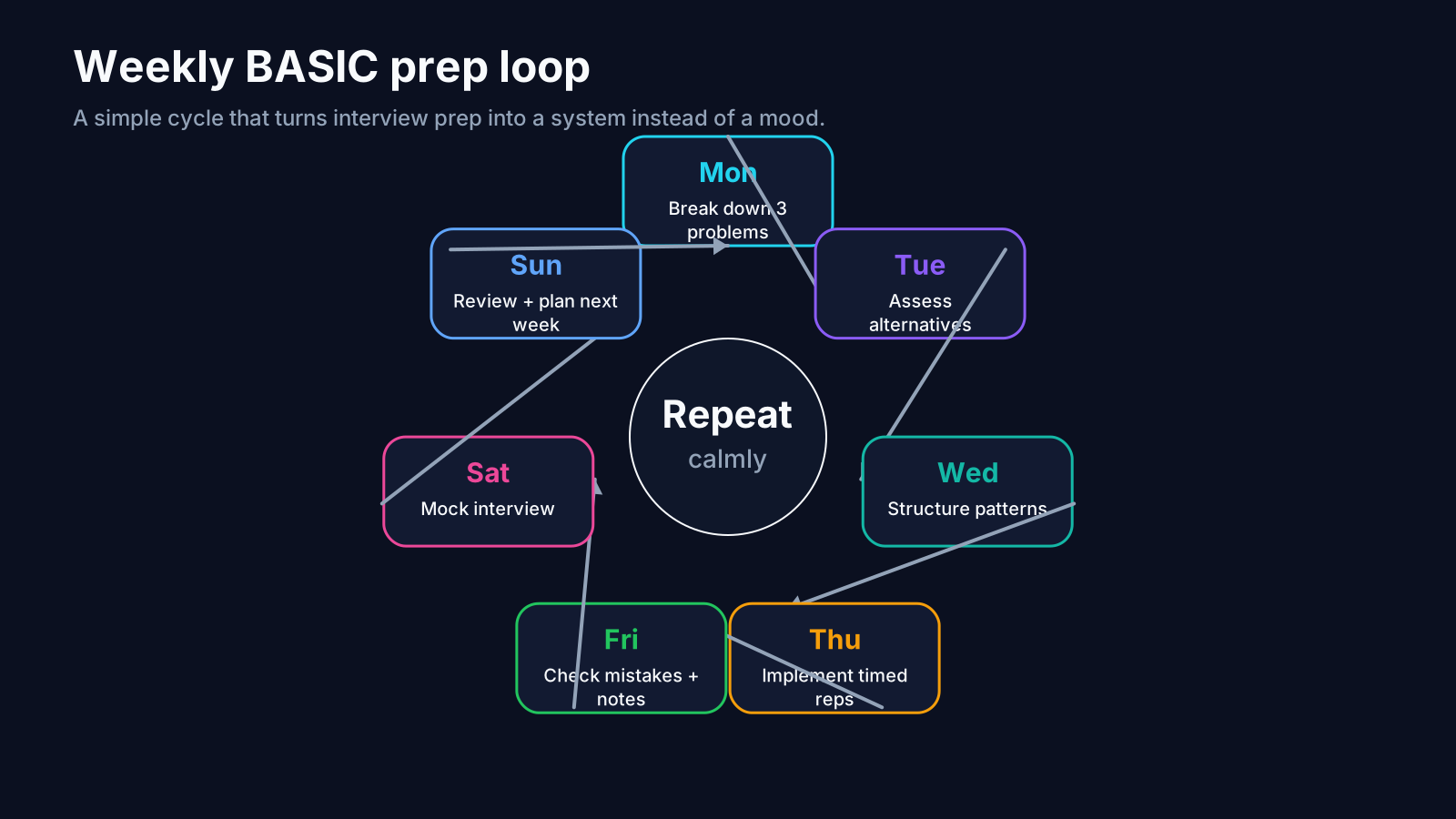
My weekly prep loop became:
Monday — Breakdown reps
Restate prompts. Extract inputs, outputs, constraints, assumptions.
Tuesday — Assess reps
Compare brute force vs optimized. Name trade-offs explicitly.
Wednesday — Structure reps
Pseudocode, invariants, diagrams, API sketches.
Thursday — Implement reps
Timed code. Clean design deep dives.
Friday — Check reps
Dry runs, edge cases, complexity, postmortems.
Saturday — Mock interview
Do the full sequence live.
Sunday — Review
What stage did I skip when I struggled?
That last question became my favorite.
Not:
- “Am I bad at dynamic programming?”
- “Why am I so unlucky with graphs?”
- “Why do interviewers hate me?”
Just:
“Which BASIC step did I skip?”
That question is smaller, fairer, and more actionable.
The sentence I wish someone had told me earlier
If I could go back and tell the version of me who was collecting rejection emails one thing, it would be this:
You do not need a more impressive brain.
You need a more reliable order.
That is what BASIC gave me.
Breakdown gave me a place to start.
Assess gave me permission to think before acting.
Structure gave me a way to make reasoning visible.
Implement gave me discipline.
Check gave me trust in my own output.
And taken together, they gave me the thing I had been missing the whole time:
interview composure
Bottom line
BASIC changed my SWE interviewing not because it made me magically smarter, but because it stopped me from solving from the middle. It gave me a stable sequence for coding, system design, and technical deep-dives. Once I had that sequence, my preparation got cleaner, my mock interviews got more useful, and my real interviews finally started to reflect the engineer I actually was.
That is why it felt life-changing.
References used in this post
This is a narrative post, but the prep logic and technical framing are aligned with the research and interview-guidance sources in this pack, especially S1 S4 S8 S9 S10 S11 S12 S15 S16.
What changed in practice, not just in theory
The turning point in the story was not one magical interview. It was the moment the candidate stopped asking, “Did I solve enough questions?” and started asking, “Which BASIC phase keeps breaking under pressure?”
That question changed the practice loop.
- If Breakdown was weak, the next session focused on clarifying prompts.
- If Assess was weak, the next session focused on baseline comparisons.
- If Structure was weak, the next session focused on saying the invariant or request flow before writing.
- If Check was weak, the next session forced dry runs and explicit trade-off review.
That is what made the progress believable. The framework did not just give confidence. It gave a way to diagnose failure precisely enough to improve it.