Why BASIC works for software engineers
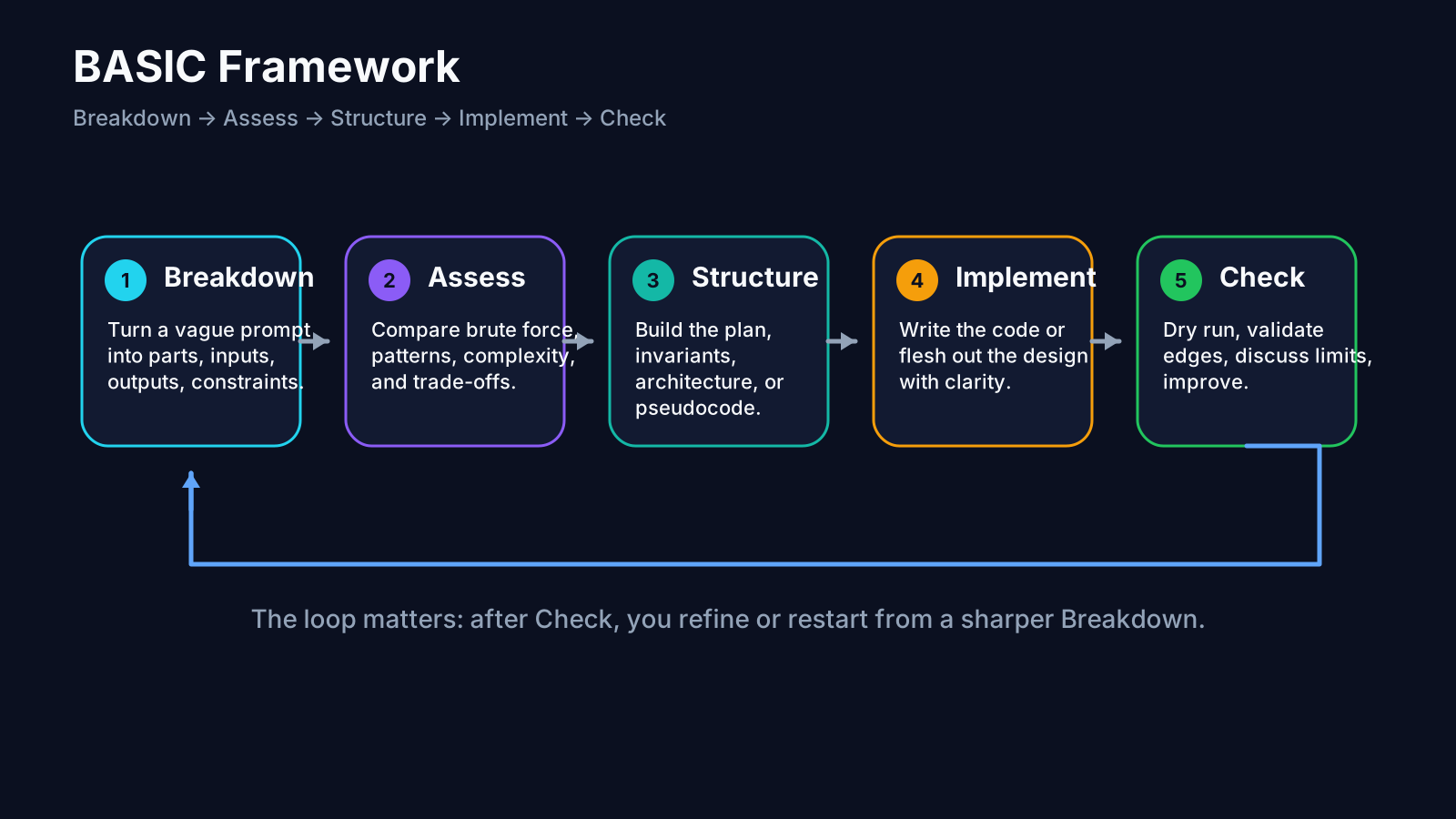
BASIC — Breakdown, Assess, Structure, Implement, Check — works for software engineers because it is not just a catchy mnemonic. It is a compact operating system for thinking under pressure. It gives the brain a repeatable order for handling ambiguity, evaluating options, externalizing a plan, executing without panic, and validating the result before the interviewer has to ask for it.
That matters because software interviews are not only knowledge tests. They are live performance tasks. You are asked to reason in public, make trade-offs in real time, and stay coherent while time pressure tries to hijack your working memory. BASIC helps by turning a large messy task into a sequence of smaller, more stable decisions. That is exactly the kind of scaffold cognitive-load and problem-solving research suggests people need when the task is complex and unfamiliar. S1 S4 S5
The real problem BASIC solves
Most interview failure is not “I have never seen the data structure.” More often it is one of these:
- the candidate starts coding before understanding the prompt
- the candidate sees multiple ideas and cannot compare them cleanly
- the candidate has a solution in their head but cannot present it as a shareable plan
- the candidate writes plausible code, then forgets to validate edge cases
- the candidate has strong knowledge in practice, but no reusable sequence when stress rises
BASIC solves those failure modes by giving each one a home.
- Breakdown handles ambiguity.
- Assess handles choice.
- Structure handles communication.
- Implement handles execution.
- Check handles reliability.
That sequence is especially powerful in software engineering because it mirrors how strong engineers already work on the job: they decompose problems, compare options, sketch designs, build incrementally, and validate before shipping.
1) Breakdown lowers the perceived complexity
Software prompts often arrive as one intimidating blob:
“Design a rate limiter.”
“Find the longest substring without repeating characters.”
“Design a chat service for millions of users.”
A weak response tries to solve the blob. A strong response breaks the blob into parts.
Breakdown asks:
- What is the actual deliverable?
- What are the inputs and outputs?
- What constraints are explicit?
- What constraints are missing and must be clarified?
- What subproblems naturally appear?
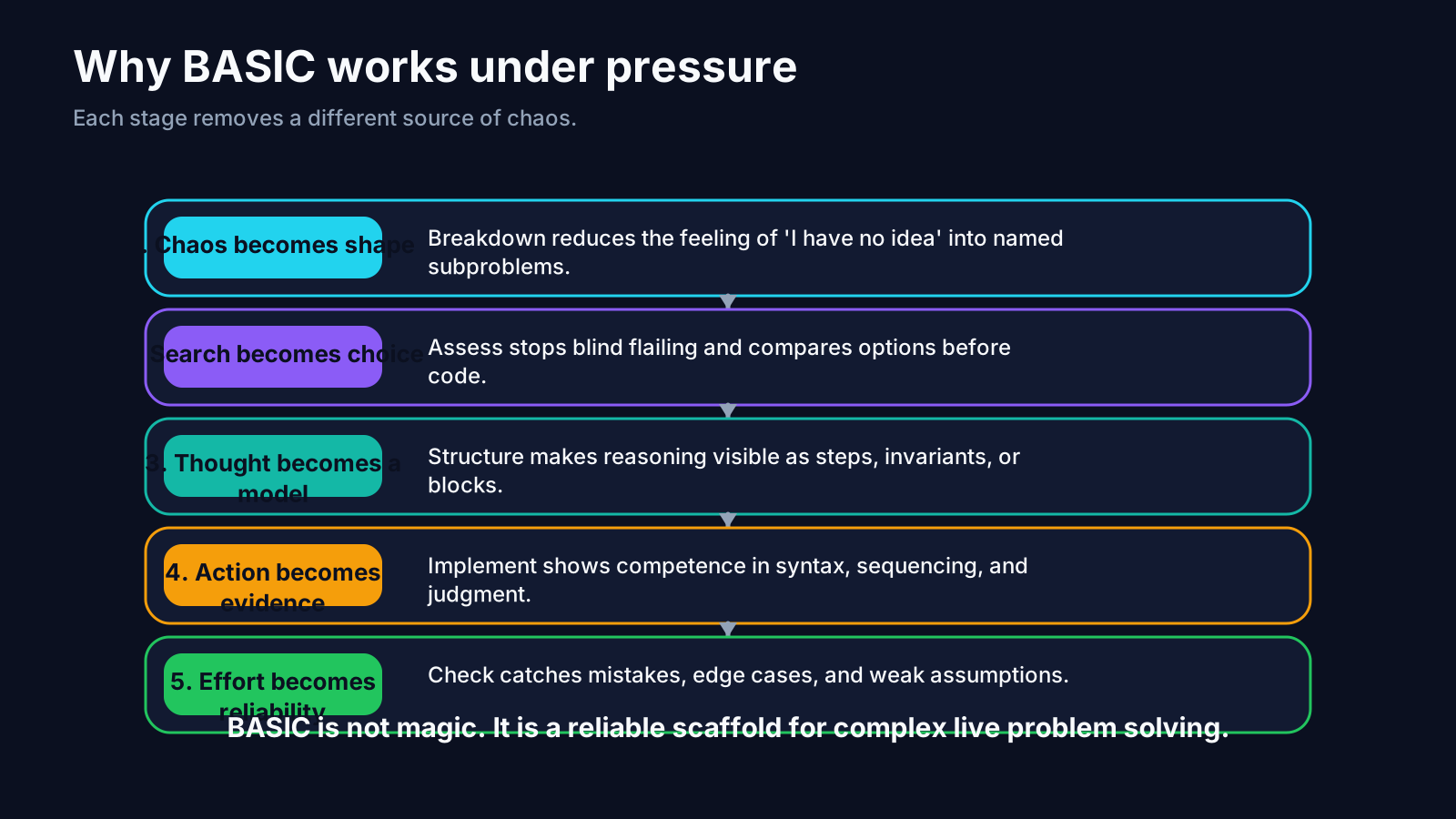
This is where BASIC earns its first big win. John Sweller’s classic cognitive-load work argued that conventional means-ends problem solving can consume the processing capacity that should be used to build schemas. In plain English: if you spend too much brainpower blindly searching for a path, you have less left to actually reason well. BASIC reduces that search cost by forcing an early decomposition step. S1
There is also an expert-novice angle here. Research comparing experts and novices found that experts distinguish themselves with strategies like subproblem breakdown, solution development, and exploring implications. BASIC makes that expert behavior explicit and repeatable. S5
For a software engineer, Breakdown is the moment you say things like:
- “Let me restate the problem to confirm the goal.”
- “I want to separate functional requirements from scale assumptions.”
- “There are really two tasks here: detecting validity and updating state efficiently.”
That language does two things at once: it calms you down, and it tells the interviewer you think like an engineer rather than a gambler.
2) Assess prevents premature coding
Many candidates lose interviews in the minute after they understand the prompt. They jump directly from recognition to implementation:
“I think this is a DFS.”
“I’ll use Redis.”
“Let me start coding.”
That jump is dangerous. The missing step is Assess.
Assess asks:
- What is the brute-force baseline?
- What patterns or architectures are available?
- What are the time/space or cost/reliability trade-offs?
- What hidden risks are present?
- Why is the chosen path better for this exact prompt?
This is where BASIC becomes more than a study tool. It becomes a decision tool.
In coding interviews, Assess is the step where you compare O(n²) brute force to a sliding window, or recursion to iterative BFS, or hashmap counting to sorting. In system design, it is where you compare strong consistency to availability, SQL to NoSQL, push to pull, sync to async, local cache to distributed cache.
That pause matters. Research on worked examples and example-problem sequences shows that reducing unstructured search helps novices learn and perform more efficiently than pure unguided problem solving. BASIC’s Assess phase is the interview version of that insight: it forces explicit comparison before action. S1 S16
A clean Assess script sounds like this:
“A brute-force version would check every candidate window in O(n²).
That gives us a correctness anchor.
But because window validity can be updated incrementally, I can reduce this to O(n) with a frequency map and two pointers.”
Or, in system design:
“If the top priority is low write latency and eventual consistency is acceptable, I’d rather separate the write path from downstream fan-out with a queue than force synchronous delivery.”
Assess is what turns raw knowledge into judged engineering taste.
3) Structure makes your reasoning visible
A lot of candidates have decent ideas but cannot make those ideas legible. Their brain is ahead of their mouth, and the interviewer sees fragments instead of a model.
Structure solves that.
Structure asks:
- What is the algorithm or architecture?
- What are the steps in order?
- What invariant, state model, or component model holds the solution together?
- What does the interviewer need to see before I start building?
This is where good technical answers start to feel calm.
For LeetCode-style questions, Structure may be:
- pseudocode
- recursion tree
- loop invariant
- state transition
- data structure choice and why it is sufficient
For system design, Structure may be:
- block diagram
- request flow
- data model
- API surface
- critical component responsibilities
- explicit bottleneck locations
Karat’s candidate guide effectively recommends a similar pattern: understand first, think through the logic and high-level structure before jumping into code, simplify where possible, and explain your trade-offs. BASIC packages those moves into one memorable stage. S10
Structure is also where interview communication stops being generic. “I communicate well” is meaningless. A structured plan is visible communication. The interviewer can now follow you, challenge you, and collaborate with you.
That is why BASIC is so strong for software engineers: it turns problem solving into a form that can be evaluated live.
4) Implement turns the plan into evidence
At some point, the work must become real. That is Implement.
Implement asks:
- Can I build the chosen solution clearly?
- Am I preserving the invariant I claimed?
- Am I narrating critical decisions, not every keystroke?
- Am I writing in a way that reduces avoidable bugs?
The best candidates do not perform “code dump mode.” They implement in a way that preserves the structure they just promised.
That often means:
- writing the skeleton first
- filling in the hardest branch second
- naming things by meaning, not convenience
- keeping the interviewer oriented on where they are in the plan
- resisting cleverness that harms readability
Amazon’s software-development guidance is explicit that technical interviews focus on coding and system design, and that interviewers care about your ability to apply what you know to solve problems efficiently and effectively. Their SDE II prep further says that well-tested, scalable, robust code and attention to edge cases are major evaluation criteria. BASIC’s Implement step is built to showcase exactly that. S8 S9
A helpful mental rule is:
Implement the model you just explained, not a second secret idea.
Candidates get into trouble when they explain one thing, then type another. BASIC reduces that drift because Structure and Implement are intentionally adjacent.
5) Check is where reliability shows up
Most candidates treat validation as optional if time is low. Strong candidates do the opposite. They know Check is not a bonus step; it is where engineering maturity becomes visible.
Check asks:
- Does the solution work on a normal case?
- What about edge cases?
- What is the complexity?
- What assumptions could break at scale?
- If I had more time, what would I improve?
This is not just good interviewing. It is good engineering.
Checklist research in complex, stressful domains emphasizes how verification aids recall, standardization, and error management. Hales and Pronovost note that checklists help because they provide guidance and a verification step after task completion, leveraging chunking and structured recall. That idea transfers cleanly to interviews: Check is your cognitive aid against skipping the obvious under stress. S4
In code, Check includes:
- dry run with a small input
- null / empty / one-element cases
- repeated values
- off-by-one boundaries
- complexity statement
- quick refactor if clarity is weak
In system design, Check includes:
- single points of failure
- hot partitions
- backpressure
- retry storms
- observability
- cost blowups
- abuse / rate limits / auth
- “what happens when traffic is 10x?”
Amazon explicitly tells candidates to ask questions to complete and validate their design and lists system-design objectives like practicality, reliability, optimization, and scalability. That is Check in employer language. S9
The sequence matters more than the acronym
The stages are powerful individually, but the order is where much of the value lives.
If you skip Breakdown, you optimize the wrong thing.
If you skip Assess, you commit too early.
If you skip Structure, the interviewer sees chaos.
If you skip Implement, the answer stays theoretical.
If you skip Check, small mistakes erase strong reasoning.
In other words, BASIC works because it matches the natural lifecycle of a hard technical task.
That is why it transfers so well across software engineering contexts:
- LeetCode
- live coding
- system design
- debugging
- architecture deep-dives
- take-home walkthroughs
- even behavioral follow-ups, when you need to analyze the technical side of what happened
A small coding example: Invert Binary Tree
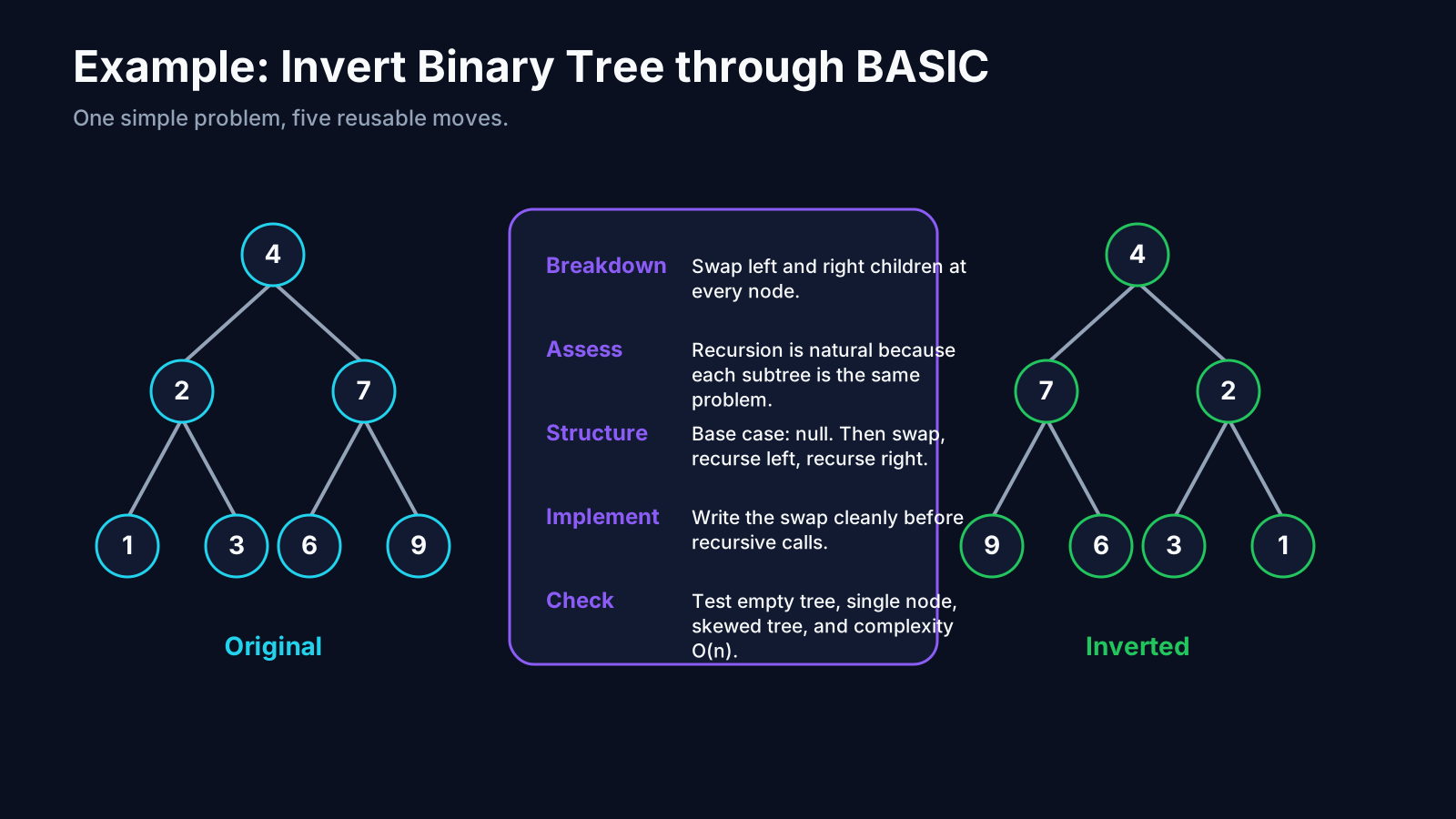
Take a simple question like Invert Binary Tree.
Breakdown
We need to swap left and right children at every node.
Assess
Brute force is not really the issue here; the important comparison is recursive DFS vs iterative BFS. Recursion is natural because each subtree is the same problem.
Structure
Base case: null node returns null.
Action: swap children.
Recurse on the children.
Return root.
Implement
Write the base case first, then the swap, then recursive calls.
def invertTree(root):
    if not root:
        return None

    root.left, root.right = root.right, root.left
    invertTree(root.left)
    invertTree(root.right)
    return root
Check
- empty tree →
None - single node → unchanged
- skewed tree → still works
- complexity → O(n) time, O(h) stack
The problem is simple, but the sequence is reusable. That is the point. BASIC teaches a process identity, not just an answer.
A small system-design example: TinyURL
Now take Design TinyURL.
Breakdown
Clarify scope: shorten URLs, redirect, maybe analytics, maybe custom aliases. Separate must-haves from nice-to-haves.
Assess
Estimate rough scale. Decide whether strong consistency is needed for alias uniqueness. Decide whether read-heavy traffic suggests caching at redirect time.
Structure
Define the main pieces: API, application service, ID generation or alias strategy, key-value store, cache, redirect path.
Implement
Deep dive into the hardest part: alias generation, deduplication, redirect performance, expired links, analytics event path.
Check
Look for hot keys, abusive traffic, cache invalidation, uniqueness collisions, observability, rate limiting, and data retention choices.
This is why BASIC works so well for system design: it prevents the candidate from saying “Redis, Kafka, CDN” before even clarifying the product.
Why this helps specifically in SWE interviewing
Software engineering interviews reward a very particular blend of skills:
- problem decomposition
- trade-off judgment
- clear externalization of reasoning
- execution accuracy
- verification and robustness
BASIC maps one-to-one onto that blend.
And the match is not theoretical. Employer and interview-prep guidance for software roles consistently emphasizes coding, system design, problem solving, trade-offs, validation, and clear explanation — not vague charisma. Amazon’s interview prep does this explicitly. Karat tells candidates to understand, optimize, test, simplify, explain trade-offs, and speak up. LeetCode describes its interview materials as a structural approach to company interview questions. ByteByteGo’s system-design guidance is likewise stepwise: requirements, capacity, high-level design, interfaces, scalability, reliability. BASIC compresses all of that into one memorable loop. S8 S9 S10 S12 S15
Practical scripts you can use immediately
Here are some interview-safe phrases that map directly to BASIC:
Breakdown
- “Let me restate the goal and confirm inputs, outputs, and constraints.”
- “I see two subproblems here…”
Assess
- “A baseline would be…, but I think we can do better because…”
- “The trade-off is time versus space / consistency versus latency…”
Structure
- “Before I code, here’s the plan.”
- “The invariant I want to maintain is…”
Implement
- “I’m going to build the skeleton first, then fill in the update step.”
- “This branch handles the duplicate / null / overflow case.”
Check
- “Let me dry run this on a small example.”
- “Edge cases I want to validate are…”
- “Time is O(n), space is O(1) aside from the output.”
Those phrases do more than sound polished. They keep your own mind in sequence.
What BASIC is not
BASIC is not:
- a replacement for technical knowledge
- a shortcut around studying data structures or distributed systems
- a guarantee that every solution will be optimal
- a reason to overtalk
It is a control system. It gives your knowledge a reliable order of operations.
That is why it feels so useful once people adopt it. The content of the problem still changes. Your response pattern does not.
Bottom line
BASIC works for software engineers because it gives structure to exactly the parts of technical interviewing that break down under pressure: ambiguity, choice, communication, execution, and verification. It echoes what problem-solving research says about cognitive load, self-explanation, examples, and expert strategy. And it matches what technical interviewers visibly reward in real SWE loops: decomposition, trade-offs, code/design clarity, and checking your own work. S1 S2 S3 S4 S5 S8 S9 S10
That combination — research fit plus interview fit — is what makes BASIC more than a mnemonic. It makes it usable.
References used in this post
S1 S4 S5 S8 S9 S10 S12 S15 S16
2026 update: why the framework still gets stronger in an AI-assisted environment
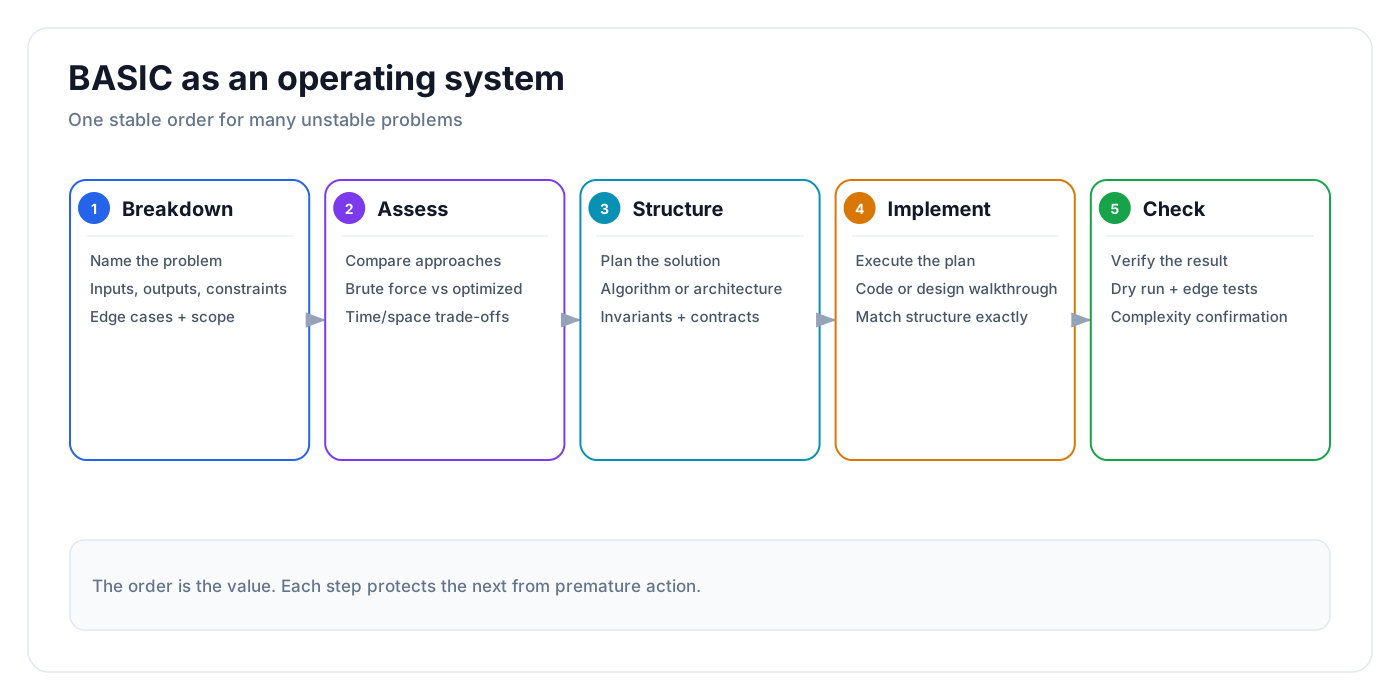
A useful way to understand BASIC in 2026 is this:
the easier it becomes to generate a first draft, the more valuable it becomes to control question quality, evaluation quality, and verification quality.
That is why BASIC still feels current in an AI-heavy workflow. It does not compete with faster implementation. It protects the reasoning that should happen before and after implementation.
For software engineers, that means BASIC now helps in three different modes:
- manual problem solving when you are writing the answer yourself
- AI-assisted problem solving when a tool helps draft or compare
- interview communication when you must make the reasoning inspectable to someone else
In all three modes, the hard part is still the same: define the task well, evaluate the options, structure the path, execute cleanly, and verify with enough rigor that you trust the answer.
Why BASIC also transfers into research and behavioral follow-ups
BASIC is especially useful because it does not stop at coding and system design.
In research, Breakdown becomes question framing, Assess becomes source judgment, Structure becomes a research plan, Implement becomes synthesis, and Check becomes source verification.
In behavioral follow-ups, Breakdown becomes identifying the real decision inside the story, Assess becomes comparing alternatives you faced, Structure becomes the arc, Implement becomes delivery, and Check becomes whether ownership, metrics, and lessons are actually visible.
That transferability matters. It means you are not memorizing five isolated interview tricks. You are learning one operating model that works across different forms of engineering judgment.