BASIC for LeetCode: the most reliable way to think through coding interviews
LeetCode is often treated like a memory contest.
That is one reason so many candidates study hard and still underperform in interviews. They are not actually failing because they never saw the topic before. They are failing because they enter the question with no dependable sequence for turning a prompt into a working solution.
That is where BASIC helps.
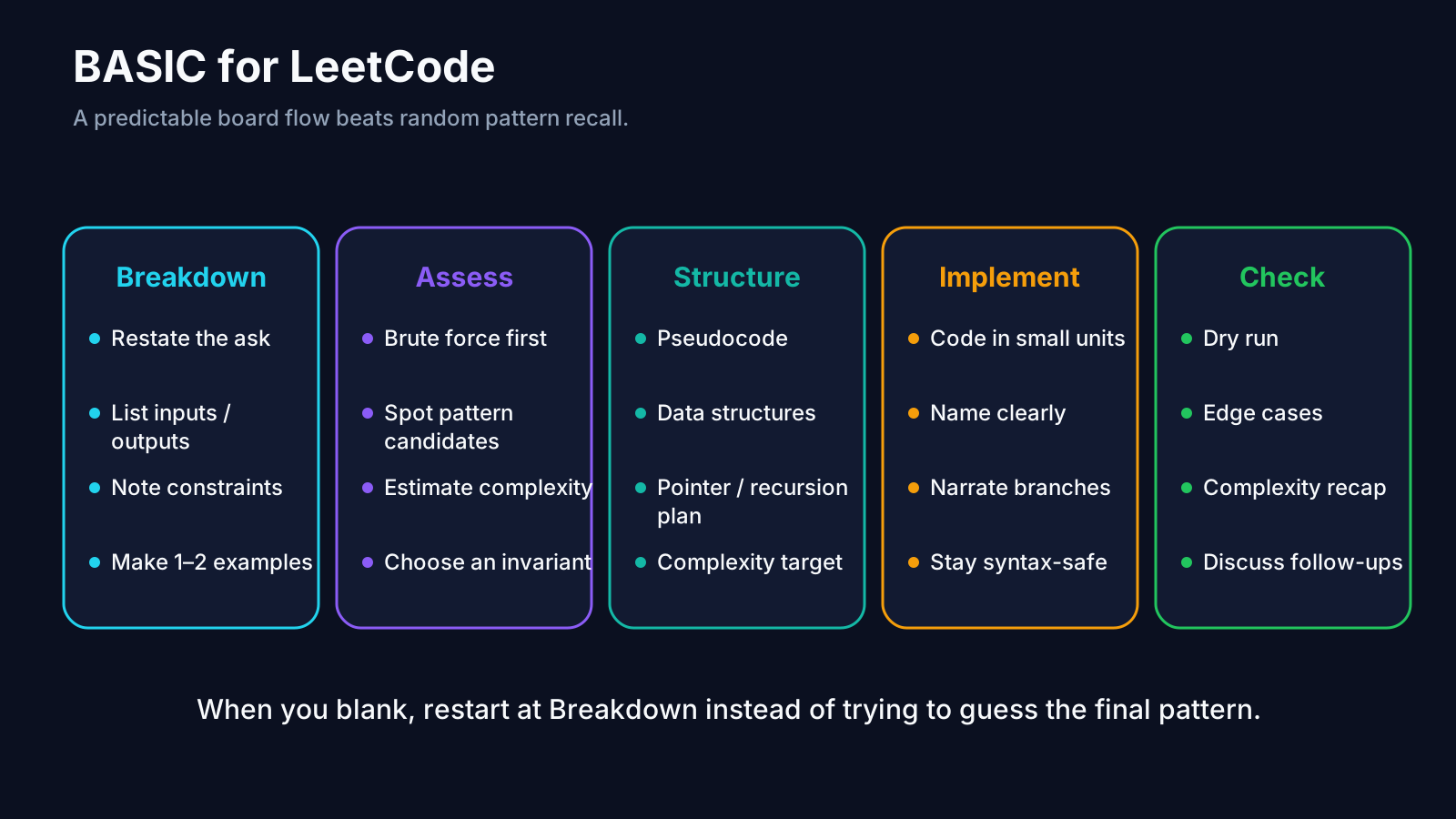
Breakdown, Assess, Structure, Implement, Check is a much better operating model for LeetCode than “stare at the problem until the right trick appears.” It takes a puzzle that feels random and turns it into a workflow you can repeat across arrays, trees, graphs, dynamic programming, and design problems. That matters because interviewers do not only care whether you eventually arrive at the right code. They care whether you can reason through uncertainty, choose a viable path, write clean implementation steps, and test your own thinking without being carried by hints. Technical interview guidance keeps returning to that same pattern: understand the problem, compare options, optimize where appropriate, and test what you wrote. S9 S10 S12 S13
Why LeetCode breaks people
LeetCode compresses several difficult tasks into a very short period of time:
- you must decode the prompt
- you must recognize the underlying pattern
- you must choose a data structure or algorithm
- you must write code without getting lost in syntax
- you must catch edge cases before the interviewer does
Without a framework, candidates solve from the middle. They start coding before they have modeled the constraints. Or they talk about three solutions without committing to one. Or they produce the core logic but forget to test null input, duplicate values, off-by-one boundaries, or time complexity.
BASIC reduces that chaos by putting the work in order.
It does not make the problem easy. It makes your thinking legible.
Breakdown: turn the prompt into an object you can reason about
In LeetCode, Breakdown is the stage that saves you from writing the wrong solution faster.
At Breakdown, you are not yet optimizing. You are identifying:
- the input and output shape
- what exactly must be returned
- the constraints that matter
- whether order matters
- whether duplication matters
- whether mutation is allowed
- whether this is asking for existence, count, minimum/maximum, or construction
This is also where you translate the problem into a known family. For example:
- “subarray” often hints at prefix sums or sliding window
- “sorted array” often opens the door to binary search or two pointers
- “top k” often suggests a heap or bucket strategy
- “tree path” often suggests DFS with state
- “course prerequisites” often hints at graph traversal or topological sort
A lot of candidates skip this because it feels slow. In reality, this is what prevents expensive rework later. LeetCode itself encourages structural learning through interview-focused study tracks rather than isolated random guessing, which lines up strongly with the Breakdown step. S12 S13
A good Breakdown sounds like this:
“We are given the root of a binary tree and need to transform the same tree in place.
Base case matters because null must be returned safely.
This looks like a traversal problem, and because every node needs the same transformation, recursion is a likely candidate.”
That is not filler. That is model-building.
Assess: compare reasonable approaches before committing
Once the problem is broken into the right object, Assess is where you evaluate the candidate approaches.
This is the stage many people rush past because they are afraid of silence. But a strong Assess phase is often what separates a candidate who looks random from a candidate who looks senior in judgment.
In LeetCode, Assess usually means:
- comparing brute force with optimized approaches
- choosing between recursion and iteration
- deciding whether the right state is local, global, or carried in parameters
- checking whether a hash map, stack, queue, heap, or pointer strategy simplifies the problem
- deciding whether the constraint size forces a particular complexity target
For example, with Maximum Depth of Binary Tree, you may assess recursion versus BFS. With Kth Smallest Element in a BST, you may assess an in-order traversal against an augmented-tree approach. With Subtree of Another Tree, you may assess direct recursive comparison versus serialization. The point is not to say everything you know. The point is to show why one path is a good fit for this prompt.
Karat’s guidance for technical interviews explicitly emphasizes understanding the prompt, optimizing intentionally, testing, and speaking through trade-offs. That is essentially Breakdown plus Assess plus Check in a different vocabulary. S10
A good Assess statement sounds like this:
“A recursive DFS is the clearest fit because the same operation applies to each node.
An iterative queue also works, but recursion is shorter to explain and matches the tree’s shape.
Time will be O(n) because we visit every node once, and space will be O(h) from the call stack.”
Notice what happened there: the candidate did not only pick a solution. They justified it.
Structure: make the algorithm visible before code hides it
Structure is where you stop holding the algorithm entirely in your head.
This is the moment to state the control flow, helper functions, invariants, and complexity target in plain language or lightweight pseudocode before implementation noise starts.
For LeetCode, Structure is powerful because it converts “I kind of know what to do” into “I have an explicit plan.” That usually means one or more of the following:
- naming the traversal order
- sketching the pointer movement
- defining the recursion contract
- identifying the loop invariant
- deciding the contents of a queue/stack/map
- identifying where the answer is updated
- deciding when to return early
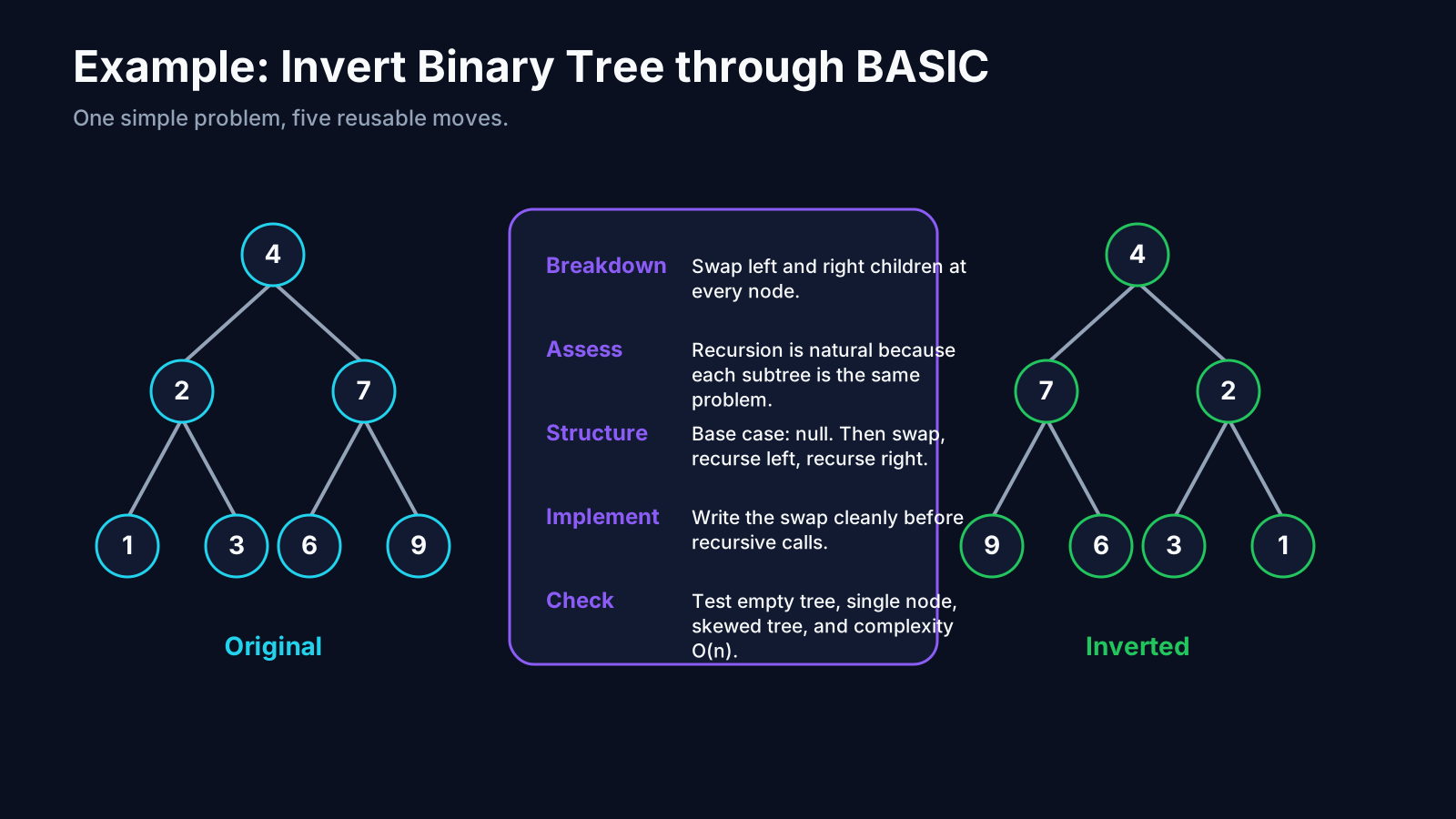
A strong Structure step for Invert Binary Tree might be:
- If the node is null, return null.
- Swap left and right children.
- Recursively invert the left subtree.
- Recursively invert the right subtree.
- Return the node.
A strong Structure step for Binary Search problems might be:
- Maintain
leftandright. - Compute
midsafely. - Use the monotonic condition to discard half the space.
- Preserve the invariant that the answer remains in the search interval.
- Stop when boundaries converge.
This stage is underrated. Research on worked examples and expert strategy strongly suggests that structure reduces wasted search and makes transfer easier across related problems. S1 S5 S16
Implement: code one stable layer at a time
Implementation is where many candidates feel the most exposed, because it is the first time the interviewer can point to an exact mistake.
But BASIC helps here too. If Breakdown, Assess, and Structure were done well, Implement becomes less like improvisation and more like transcription.
What good LeetCode implementation looks like under BASIC:
- start with the function signature and base cases
- write the skeleton that matches your structured plan
- fill one logical block at a time
- narrate important steps, not every character
- resist “clever” shortcuts that make debugging harder
- keep variable names aligned with the model you already explained
This matters because coding rounds do not only test whether you can discover the answer. They test whether you can build it cleanly under pressure. Amazon’s technical prep materials explicitly call out the importance of practicality, accuracy, efficiency, reliability, and well-tested code. S8 S9
A useful self-command during Implement is:
“Do not add new ideas while coding unless the existing plan is clearly broken.”
That one sentence prevents a huge amount of interview chaos.
Check: where many borderline candidates become strong candidates
The Check step is the most underused part of LeetCode prep and one of the highest-leverage parts of actual interviews.
Candidates often think the interview ends when the function compiles in their head. But interviewers are also evaluating whether you can verify your own work. Check is where you dry-run, stress-test, and clean up the answer before being prompted.
A serious LeetCode Check includes:
- walking through the given example
- testing a minimal edge case
- testing a degenerate edge case
- confirming time and space complexity
- making sure the algorithm matches the original requirement
- optionally naming an alternative approach and why you did not choose it
For trees, the edge cases might be null, single-node, or skewed shapes.
For arrays, it might be empty input, duplicates, or all-same values.
For graphs, it might be disconnected components or cycles.
For dynamic programming, it might be the smallest base state.
Check is not a cosmetic final polish. It is an error-management layer. That is exactly the kind of value checklists and verification routines are known to provide in complex, stressful work. S4
Example: using BASIC on “Invert Binary Tree”
Let’s make this concrete with a canonical tree problem.
Breakdown
We need to mirror the tree by swapping every node’s left and right child. Input is a root node. Output is the same tree, inverted. Null input must return safely.
Assess
Because the same transformation must happen on every node, recursion is natural. An iterative BFS would also work, but recursion is more direct for explanation and implementation.
Structure
- base case: null returns null
- swap left and right
- recurse into both children
- return the root
Implement
Write the null guard, perform the swap, recurse, return the node.
Check
Run the code on:
- empty tree
- single node
- the example tree with both left and right subtrees Then confirm O(n) time and O(h) stack space.
What BASIC did here was not invent a new algorithm. It removed ambiguity from how to express the algorithm in an interview.
That is why BASIC scales so well across LeetCode. Most problems are not asking for mystical insight. They are asking for controlled problem reduction.
BASIC changes how you study LeetCode too
The framework is not only for live interviews. It is a much better way to practice.
A useful BASIC-driven study loop looks like this:
Breakdown practice
Before reading editorials, classify the prompt. What family is it in? What are the constraints? What would break a naive solution?Assess practice
Force yourself to name at least two approaches. Even if one is obviously worse, say why it loses.Structure practice
Write pseudocode or an invariant before touching the final solution.Implement practice
Code from the plan, not from memory fragments.Check practice
Dry-run by hand, then write a short note explaining why the solution is correct.
This matters because retrieval, reconstruction, and self-explanation tend to produce stronger learning than passive review. S2 S3 Re-solving a previously missed problem by reproducing the BASIC stages is usually more valuable than merely rereading the editorial and thinking, yes, that makes sense now.
What BASIC prevents in LeetCode interviews
BASIC is especially good at blocking five common failure modes:
1. Pattern panic
You see a familiar problem type but cannot remember the exact solution.
BASIC helps because you can still break the problem down, assess options, and rebuild the algorithm from first principles.
2. Premature optimization
You try to jump straight to the best-known solution before establishing correctness.
BASIC forces you to justify the trade-off after understanding the prompt.
3. Coding from the middle
You start implementing helper logic before stating the full control flow.
Structure prevents this.
4. Silence that looks like confusion
Interviewers do not know whether you are thinking clearly or frozen.
Breakdown and Assess make your thinking visible without oversharing.
5. False confidence
You finish coding and stop.
Check catches the bug that would otherwise become the interviewer’s follow-up.
BASIC by pattern family
Here is what BASIC tends to emphasize across common LeetCode families:
- Arrays / strings: boundaries, indexes, mutation rules, duplicate handling
- Two pointers / sliding window: movement invariant, window condition, when to expand or shrink
- Trees: recursion contract, traversal choice, base cases
- Graphs: visited policy, traversal order, adjacency representation
- Heaps: what is being prioritized and why
- Dynamic programming: state definition, transition, base cases, iteration order
- Binary search: monotonic property, interval invariant, termination condition
That is the hidden advantage of BASIC: it is stable even when the pattern changes.
A better way to sound in LeetCode interviews
Candidates often ask what they should say.
Here is a useful BASIC-style LeetCode script:
- “Let me restate the problem and confirm the input/output.”
- “The constraints suggest we should avoid O(n^2) if possible.”
- “I see two possible directions: X and Y. I’ll choose X because …”
- “My plan is …”
- “I’ll code the base case first, then the main loop/recursion.”
- “Before I stop, I want to test the edge cases and confirm complexity.”
That script sounds calm because it is calm. It is not performance fluff. It is sequence.
Bottom line
LeetCode gets much easier to handle when you stop treating each question as a separate act of genius and start treating it as a repeatable decision process. BASIC gives you that process. Breakdown helps you model the problem correctly. Assess helps you choose intentionally. Structure helps you make the plan visible. Implement keeps the coding disciplined. Check gives you a verification layer before the interviewer has to rescue you.
That is why BASIC works so well for LeetCode: it does not depend on memorizing every problem. It teaches you how to move through the problem.
References used in this post
S1 S2 S3 S4 S5 S8 S9 S10 S12 S13 S16
The 2026 angle: BASIC is also an anti-autopilot system
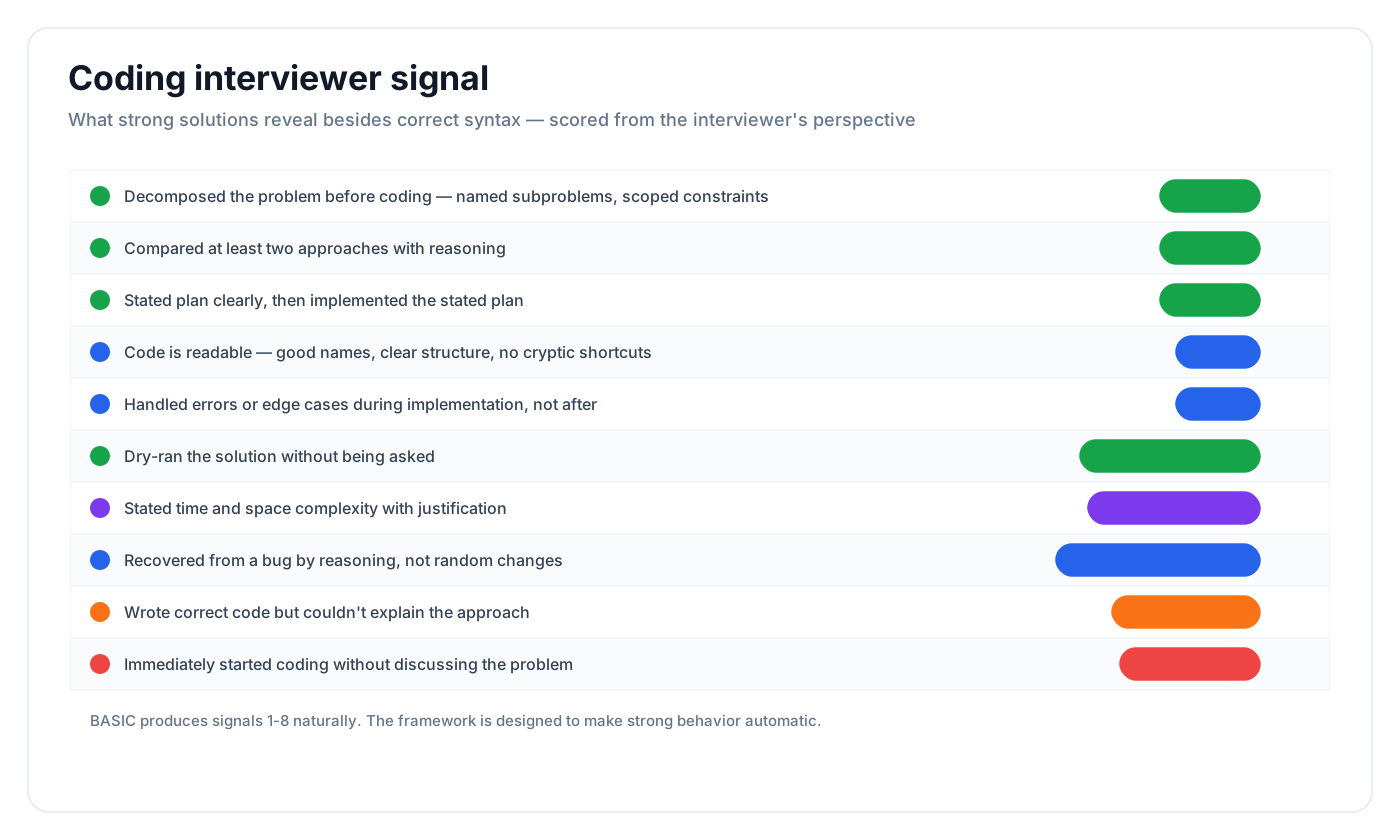
In an era where patterns, snippets, and first drafts are easier to access, a lot of candidates fall into a new trap: they recognize a family of problem and stop thinking too early.
BASIC is useful here because it slows the candidate down at the right places:
- Breakdown forces the exact deliverable to be named.
- Assess forces the baseline and the pattern choice to be defended.
- Structure forces the invariant to be explicit.
- Check forces the answer to be trusted for a reason.
That is why BASIC for LeetCode is not just a memory aid. It is an anti-autopilot system.